


Krog’s Quest →
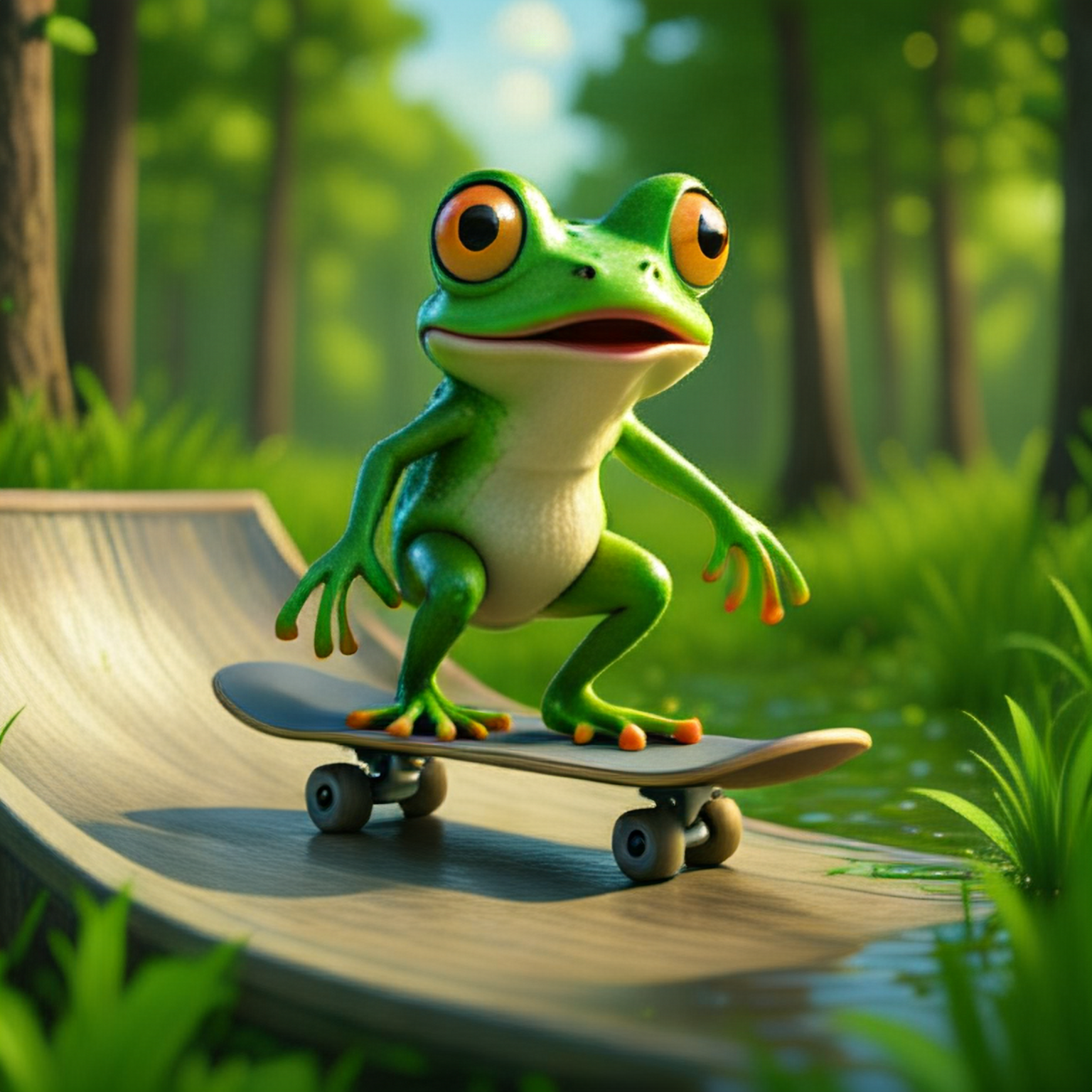
Krog never meant to leave. One day he was pushing his son Taddy on the halfpipe behind their lily pad, and the next he was gone — chasing a dream of becoming the first amphibian to land a 900 on the professional circuit. That was seven years ago. The dream died somewhere between a shattered ankle and a repossessed skateboard, and Krog spent the years since drifting between odd jobs and empty motel ponds.
Now he’s back. Taddy is thirteen, furious, and — to Krog’s bewildered pride — the best young skater in the entire marsh. He wants nothing to do with his father. But when the annual Bog Bowl competition is threatened by a corporate development project that would pave over the wetlands, Krog and Taddy find themselves forced into an uneasy alliance.
Krog’s Quest is a story-driven skateboarding adventure where every trick you land and every conversation you navigate brings a broken family closer together — or pushes them further apart. The game features a fully physics-based skating system built around the unique biomechanics of a six-foot frog, including tongue-grinds, lily-pad transfers, and the signature move that ended Krog’s career: the Croak Spin.
Explore the sprawling wetland world of Bogside County, from the neon-lit drainage ditches of downtown to the overgrown concrete parks hidden deep in the marshland. Meet a cast of unforgettable characters — Krog’s long-suffering ex Lily, the enigmatic turtle sensei Master Shell, and the menacing real estate tycoon Sal Amander — each with their own stories that interweave with Krog’s journey toward redemption.
The dialogue system tracks your relationship with Taddy across dozens of variables. Are you the dad who shows up to practice, or the one who makes promises he can’t keep? Every choice ripples forward, affecting not just the story but the tricks Taddy is willing to learn from you and whether he’ll trust you when it matters most.
Featuring an original soundtrack blending lo-fi hip hop with swamp blues, Krog’s Quest is equal parts Tony Hawk and Pixar — a game about second chances, the bonds that survive abandonment, and the simple truth that it’s never too late to drop in.

Daddy Danny →
Nobody remembers when Daddy Danny took power. There are records, presumably — somewhere in the Ministry of Engagement there must be a file, a date, a document with a signature — but asking about it is the kind of thing that gets your streaming license revoked. What everyone knows is that Daddy Danny has always been Supreme Leader, that his smile is on every billboard from coast to coast, and that tonight, like every night, viewership is mandatory.
At 8:00 PM sharp, every screen in the nation flickers to life. There is no opt-out. There is no mute button. Daddy Danny is live on Twitch, and the law requires your full, enthusiastic attention. He plays video games — exclusively, obsessively, for hours — and the nation watches. Chat participation is monitored. Insufficient use of emotes is flagged. Last month, a man in Sector 7 was reported by his own smart refrigerator for looking at his phone during a boss fight. He hasn’t been seen since.
The games Daddy Danny plays are not normal games. They can’t be. Daddy Danny does not tolerate repetition. He does not tolerate predictability. He does not tolerate the feeling of having seen something before. And so, deep beneath the Palace of Content, ten thousand software developers work in rolling shifts to build his games in real time. They have no contact with the outside world. They sleep in pods. They are fed through tubes. Their sole purpose is to ensure that every moment of Daddy Danny’s gameplay experience is novel, surprising, and exactly calibrated to his preferences — preferences that change by the hour and are communicated through a system of colored lights mounted above each developer’s workstation.
Green means Daddy Danny is pleased. Yellow means he is bored. Red means someone on the content team is about to disappear. The lights are never off.
You are Developer 4,217. You have been underground for three years. You write procedural terrain generation for a game that has no name, no genre, and no design document. Yesterday you were building a fishing minigame. Today the lights went yellow and now you are building a cathedral that bleeds. You are very tired. You are very good at your job. And this morning, for the first time, you found a note wedged behind your monitor that was not part of any sprint planning document. It said: “The stream has a four-second delay. That’s enough.”
Daddy Danny is a dystopian strategy game about resistance from the inside. You manage your team of developers through an increasingly unhinged production cycle, hiding subversive code in the game-within-the-game while maintaining the appearance of perfect loyalty. Every asset you build, every system you design, every line of dialogue you write for Daddy Danny’s ever-shifting fantasy world is an opportunity — to embed a message, to smuggle information, to plant the seeds of something the regime’s content moderators won’t catch until it’s too late.
But the moderators are not stupid, and Daddy Danny himself is sharper than anyone gives him credit for. He didn’t hold power this long by missing details. The game tracks your exposure across multiple systems — code reviews, behavioral surveillance, mandatory enthusiasm assessments — and one wrong commit to the wrong branch will end everything. You are building a revolution inside a video game being played live by the most powerful man in the world, and sixty million people are watching.
The question isn’t whether you can change the game. The question is whether Daddy Danny is already playing you.

Dartelen in de Tulpenvelden →
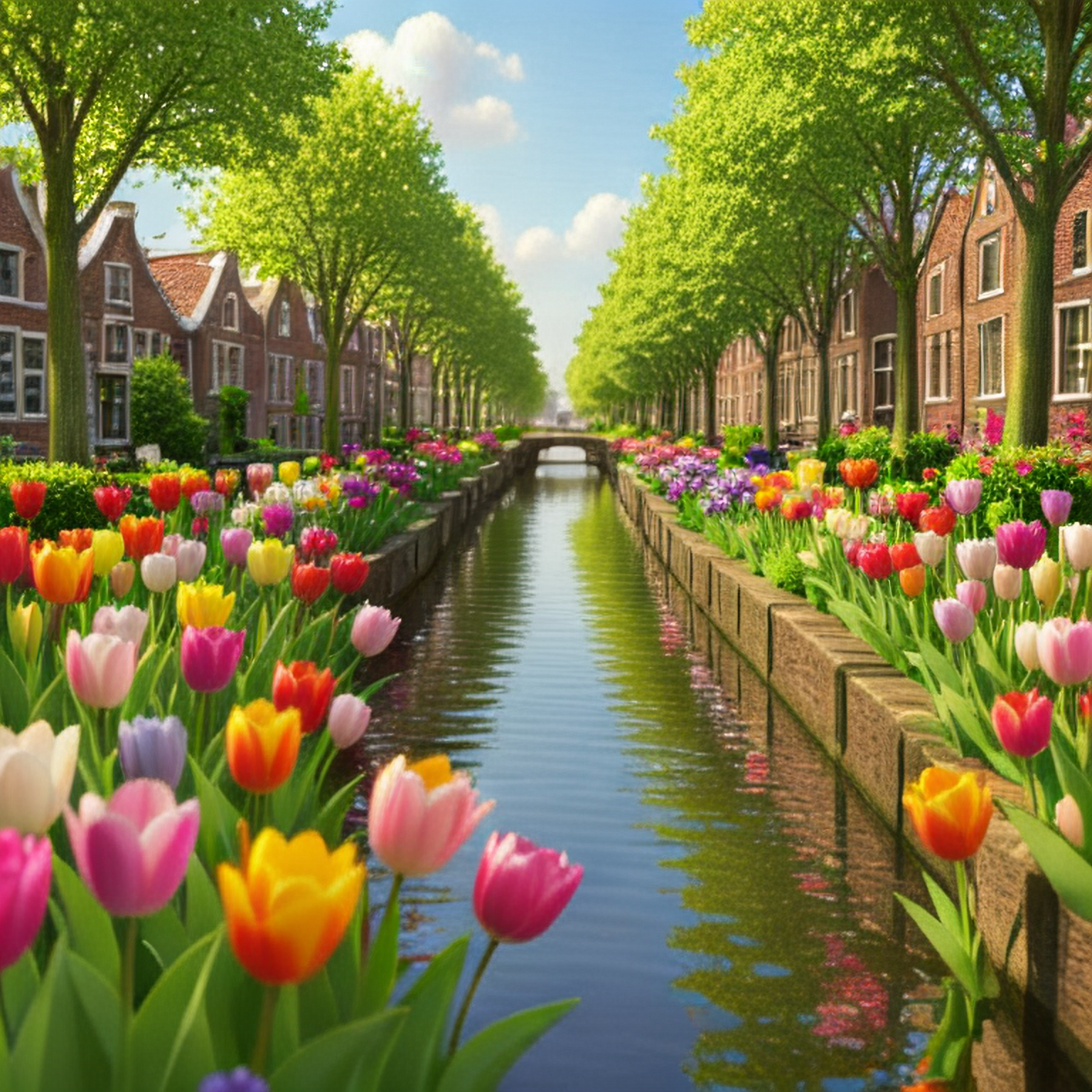
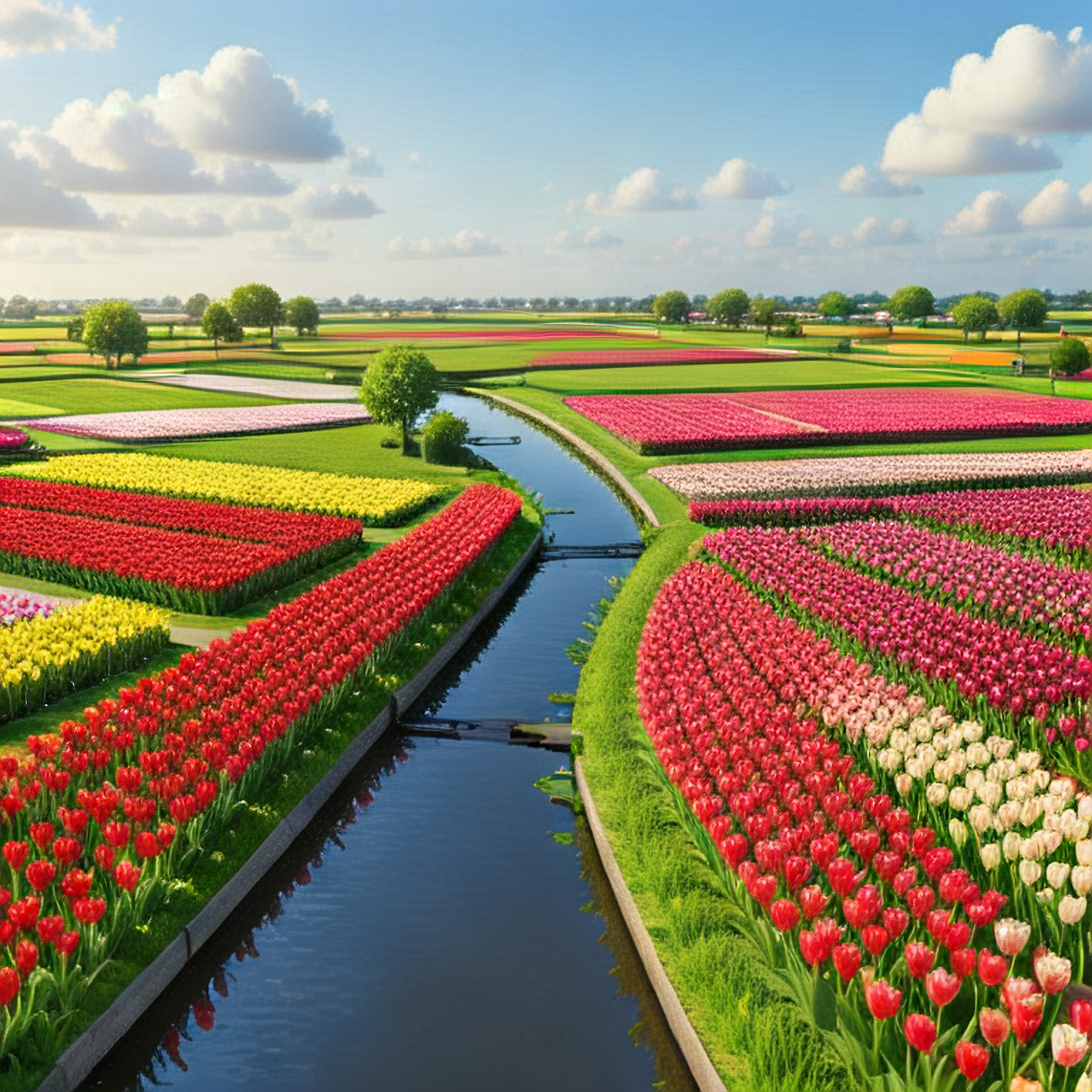
De zee is boos. De zee is altijd boos. Maar jij hebt een plan, een schep, en een onverwoestbaar geloof in goede fietspaden. Welkom bij Dartelen in de Tulpenvelden, het ultieme simulatiespel over de grootse Nederlandse traditie van de zee vertellen dat zij hier niet meer welkom is.
Jij bent de Opperpoldermeester. Het land dat je bestuurt bestaat nog niet — het is momenteel water, en het water vindt dat prima. Maar het gemeentebestuur heeft besloten dat hier een woonwijk moet komen met minstens drieduizend woningen, een overdekt zwembad, vier basisscholen, en een fietspad dat zo breed is dat je er met zes man naast elkaar kunt fietsen zonder dat iemand “sorry” hoeft te zeggen.
Begin met het strategisch storten van zand in gebieden waar de vissen het toch al niet zo leuk vonden. Bouw dijken die stevig genoeg zijn om de Noordzee tegen te houden maar ook mooi genoeg om op te picknicken. Onderhandel met boze garnalen. Stel milieueffectrapporten op die niemand leest maar die wel juridisch waterdicht moeten zijn — een woordgrap die in dit spel letterlijk van levensbelang is.
Zodra je land droog is, begint het echte werk. Leg een netwerk van gescheiden fietspaden aan met voorrangskruisingen, windschermen, en die speciale rode verf waar Nederland het patent op heeft. Plant tulpen langs elke route — niet omdat het moet, maar omdat het kan, en omdat een fietspad zonder tulpen gewoon een zielig stuk asfalt is. Ontwerp parken die zo groen zijn dat satellieten denken dat er een nieuw bos is verschenen.
Maar pas op: de bewoners hebben eisen. De gepensioneerden willen bankjes om de vijftig meter. De studenten willen een coffeeshop op fietsafstand. De kinderen willen een speeltuin met een klimrek in de vorm van een windmolen. En iedereen — werkelijk iedereen — wil een Albert Heijn op loopafstand. Het stedenbouwkundig planningssysteem houdt rekening met meer dan driehonderd variabelen, waaronder windrichting, zonlichthoek, en de gemiddelde lengte van de bevolking.
Het weer is je grootste vijand. De regen komt zijwaarts. De wind blaast je tulpen plat. En eens in de zoveel jaar verschijnt er een storm die je herinnert aan het fundamentele probleem van wonen op land dat je zelf hebt verzonnen. Je waterbeheersysteem moet kloppen, je gemalen moeten draaien, en als je het verprutst staat heel je prachtige fietsenparadijs onder water en moet je opnieuw beginnen.
Dartelen in de Tulpenvelden is een spel over de schoonheid van infrastructuur, de vreugde van een goed aangelegde rotonde, en het diepe Nederlandse vertrouwen dat elk probleem opgelost kan worden met voldoende planning, polders, en fietspaden. Inclusief een volledige campagne, een zandbakmodus, en een multiplayerstand waarin je met vrienden kunt discussiëren over de optimale breedte van een fietsstrook.